Vários autores escrevem neste blog pluralista, e nenhum deles é "obrigado" a concordar com outros. Inclusive as divergências, seguindo padrões habituais do debate acadêmico, são bem vindos.
“Era naturismo en familia, sin connotación sexual”, disse o dono da escola-veleiro Léonide Kameneff, preso em Venezuela em 2008, extraditado e condenado em Paris neste março a 12 anos de prisão por abuso sexual de cinco dos mais de 500 jovens, tipicamente entre 11 a 13 anos, que participaram do projeto educacional alternativo entre 1979 e 2002.
Parte da defesa do Kameneff era que o nudismo abordo do veleiro refletia os "ventos de liberação" de 1968. A condenação pode indicar para o naturismo brasileira a direção em que o vento está soprando.Vale notar as mudanças de padrões; a comercialização de nudez infantil por meio de filmes; e os lideres "carismáticos" e as regras que criaram uma "prisão psicológico".
"Normal na época"
A mudança de padrões foi um argumento de Kameneff para justificar a nudez abordo do navio, conforme o site DNotícias de Portugal:
Na sua página na Internet, a associação, suspensa desde 2008,
descreve uma "experiência emancipadora", uma "alternativa à educação e
aprendizagem" dos colégios convencionais, "rica em descobertas".
Em declarações antes do início do julgamento, a 5 de Março, Kameneff
defendeu que certas condutas atualmente vistas "com suspeita" eram algo
de habitual à altura dos factos.
"Em suas motivações, o Tribunal Criminal concluiu que "a atração pedófilo de Leonid Kameneff foi bem antes do barco-escola e os acontecimentos de maio de 1968". "A violação e agressão sexual cometidos contra meninos por mais de 20 anos não se encaixam tudo no contexto de uma era supostamente permissiva, mas no contexto de uma sexualidade desviante", disse o julgamento do Corte.
A nudez casual, especialmente entre crianças e quando todos eram do mesmo sexo, já foi bem mais aceito. A Justiça pode punir hoje o que ninguém questionou ontem. Vimos nos EUA pais sendo dedurados por laboratórios fotográficos devido a fotos de crianças no banho. Dr. Cec Cinder observa no seu monumental "The Nudist Idea" de que na Alemanha nos anos 30, era permissível imprimir fotos de crianças peladas, mas adultos não podia: e agora a situação se inverteu.
Filmes de crianças peladas
Houve pelo menos um filme feito das viagens do veleiro de Kameneff,"Western Lights", ainda disponível pelo Amazon e postado em onze partes no YouTube. IMDB lista Kameneff como escritor, e seu co-réu (que foi inocentado) Bernard Poggi como diretor. Um dos comentários no Amazon afirma que "o filme é a condensação para duas horas de um documentário de 13 episódios feitos para televisão francês." Um leitor critica a descrição do produto no Amazon: enfatiza "meninos bronzados", "aventureiros jovens e bonitos", e "natação pelado como nos velhos tempos". O que leva pessoas a comprar um filme destes?
Vale notar que outros filmes semelhantes sempre seguiram os passos do naturismo brasileiro. Richard West fez filmes tipo "Nude in the South of Brazil" na Colina do Sol, entre outros lugares. Suas filmes renderem processos para uso indevido de imagens de menores, um ainda correndo (ou engatinhando) na Justiça brasileira.
Mais recentemente, foi feito vários filmes pelo documentarista Peter Dietrich no Brasil estão disponíveis no site enature.net. Parte das imagens são claramente da Praia do Abricó. Quando fui lá ano passado perguntei dos filmes, e vários pessoas da praia me informaram que os "naturista" nunca aparecerem antes, ou depois. Um conhecedor de todas as áreas naturistas do Brasil me falou que não reconheceu nenhuma das pessoas que aparecem. Pessoas? Devo dizer, crianças. As descriçoés de enature.net falam do "grupo de naturistas jovens", de "festa de 13 anos", e as imagens mostrem tão-somente crianças e adolescentes.
E um filme, num veleiro.
Mas é tudo legal, não é? Bem, houve uma companhia chamado de "Azov Films", cujo site tinha um resenha detalhada do que a lei permitia e o que não, e como seus filmes estavam estritamente dentro da lei. Foi fechada pela polícia de Canadá em 2011, sua lista de assinantes repassada para o FBI americano, que passou a prender os fregueses no último trimestre de 2012. E vale lembra que quando o presidente da FBrN foi preso em 2007, os filmes e revistas de "Brasil Naturista" foram usados como evidência para manter-lo preso.
Lideres, filosofias, ideologias
No processo foi descrito uma "ideologia" de nudez frequente, massagens conjuntos, e relações sexuais entre menores e adultos. As matérias em conjunto descrevem um "prisão psicológico" de crianças isolados dos seus pais, sob a batuca de um "guru" carismático.
A naturismo brasileiro não tem uma "ideologia". Tem uma "filosofia". Nas minhas conversas com antigos frequentadores da Colina do Sol, ouvi da pressão para participar dos trabalhos "voluntários": quem não participava sofria represálias. E presenciei e documentei a pressão contra quem desafiava as acusações falsas de pedofilia orquestradas pela corja da Colina em 2007.
Filmes de crianças? Guru? Veleiro? Ideologia? Bajulação pela mídia? Conheço esta história. A demora para conseguir a Justiça, conheço também. Mas Léonide Kameneff, agora com 76 anos, que escapou durante décadas, deveria levar o restante dos seus dias atrás de grades. Espero que o fim aqui segue o de lá.
Em função da matéria “Nudistas da Praia do Abricó não aconselham topless em Copacabana”, na qual fala de ginastas dinamarquesas fazendo topless, e as respostas de alguns naturistas de Abricó para o portal G1, suscitou alguns comentários muitos interessantes nas listas de discussão sobre naturismo.
O naturismo é NORMAL , é simples, sem complicações. É necessario levar e mostrar isso as pessoas comuns. Sair fora de "guetos" e "locais escondidos" é necessario. Certamente uma associação deve recomendar para famílias locais "seguros", porem isso não deve limitar e nem inibir ações que desejem mostrar a população em geral a forma simples e sem complicações que é a nudez. Abaixo é reproduzido alguns desse comentários:
Cada vez entendo menos e me decepciono mais com as declarações de alguns naturistas quanto à nudez e, agora, especificamente quanto ao topless praticado pelas ginastas dinamarquesas em Copacabana.
Quer dizer que seios nus como forma de exibicionismo, tipo no carnaval e pelas meninas para atrair turistas pode? Mas, exibir naturalmente os seios ou o corpo totalmente nu não pode; tem que ser escondido entre pedras altas, num local quase inacessível, como se a nudez fosse em si uma ofensa. Lamentável que alguém da Associação de Abricó condene seios à mostra na praia de Copacabana em pleno século XXI, com a argumentação esdrúxula de que havia prédios por perto.
Quem luta pelo naturismo, pratica o naturismo, deveria lutar pelo nu, pela liberdade de estar nu em qualquer lugar e não pela nudez entre quatro penhascos! E essa desculpa de que os brasileiros não estão preparados para isso me cheira à mesma argumentação usada durante um tempo negro da nossa história de que nosso povo não sabia votar...
O ato em favor da nudez realizado no Ibirapuera serviu para provar o contrário e para calar a boca dos que querem o naturismo emparedado. Provou que, sim, o povo está preparado para aceitar civilizadamente a nudez pública, sem muros nem penhascos. A Pedalada Pelada deste ano ocorreu sem incidentes, com a Polícia apenas dando proteção aos participantes.
Nunca é demais lembrar que a evolução só acontece quando se avança, e só se avança quebrando tabus, dogmas, paradigmas, ousando. Ou será que alguém ainda pensa que a terra é quadrada e é o centro do universo?
Acordem naturistas!
Verdade este comentário.
Também estou procurando entender como o Naturismo está se comportando frente a estes fatos.
Nudez pode no Carnaval em todos os momentos, parece tudo liberado, mas o topless é mal visto ou pouco tolerado devido falta de entendimento ou consciência da população. Se uma pessoa denunciar ou se chocar, não se pode fazer.
Engraçado que neste país a corrupção, o roubo de verbas públicas, as falcatruas, maracutaias não chocam e ninguém denuncia ou fica indignado, mas diante da nudez há um clamor geral.
Se a manifestação ocorrida no Ibirapuera acontecesse com maior frequência, talvez pudéssemos ter uma clara noção da mentalidade do povo. Ou aceitariam e entenderiam ou seria proibido totalmente, porque, com certeza teriam reclamações e denúncias de atentado ao pudor, o que não ocorreu desta vez.
Por que atentado ao pudor, se as autoridades e governantes não tem pudor nenhum e nem vergonha na cara? Isto precisa ser repensado.
Recentemente estive no Rio de Janeiro com um casal de espanhóis e a mulher fez topless na praia de Copacabana. Ela fez perto de um posto policial, mas antes perguntou aos policiais se não teria nenhum problema e eles disseram que não e que ela poderia fazer topless.
Dai entendemos que as pessoas não fazem porque não querem... porque a polícia até dá proteção.
Mas tem uma coisa: quem não quer fazer também não quer que ninguém faça e aí denuncia.
E os comentários dos naturistas não foram felizes, já que se eles atingiram um estágio evoluído de liberação do corpo, porque limitar a evolução dos outros.
Precisamos de mais espaços e não se limitar aos já existentes.
Devemos pensar em sair do casulo e se mostrar mais no naturismo, perdendo o medo que sempre nos foi imposto por ideias e comentários errados a respeito.
Os naturistas devem defender mais o naturismo para que ele saia da condição marginal.
A questão naturismo, ainda esbarra no “socialmente correto”, e as pessoas que no final de semana fazem parte dos encontros naturistas, em chácaras “fechadas”, não querem ser descobertos na segunda feira pelo seu chefe ou pessoal da empresa que trabalha.
Na igreja que frequenta, em sua família muita das vezes..... então os naturistas ficam na defensiva.
Em Copacabana, praia que sempre foi motivo de alegria aos cariocas, deve ser sim praia do TOPLESS.
Quem deseja tirar tudo, vai para ABRICÓ.
O topless nas praias brasileiras não é “proibido”, e segundo o principio ontológico do direito o que não é proibido é permitido; porem como nossas leis são ridículas, basta uma “autoridade” se sentir no direito de reclamar ao “pudor da família” e pronto, policia armada, todos na delegacia para “registro do BO”.
Tento por vias políticas fazer uma “lei federal”, dando total amparo ao TOPLESS em todas as praias brasileiras. Segundo o senador Suplicy existe a tal bancada evangélica que é totalmente contra esta ideia... mas vamos tentando...
O ato no Ibirapuera deve ser feito, incentivado, dado total e amplo apoio. Mostra que o naturismo é NORMAL, é simples, e NATURAL.
Se não houve na primeira vez ninguém contra, vamos fazendo e quem sabe nunca terá uma denuncia.......
Mas um advogado deve ser avisado, e ficar de sobre aviso no dia da ocorrência.
Three protests with nudity have received ample coverage in the Brazilian press over the last week. It's high summer, and also the start of the college year, which may be partly responsible.
Sunday of last week in Ibirapuera Park in the center of São Paulo, South America's largest city, thirteen people preaching "peace and love" took off their clothes in support of the right to non-sexual nudity. The police received no complaints, and photos in the media received thousands of "likes" and hundreds of comments.
This Friday in the city center, a group of university students held a maracatu - an African-based drum and dance celebration - including shirtless members of both sexes.
In the upstate city of São Carlos, a freshman initiation ceremony to pick "Miss Freshman" attracted a protest by feminists, and a counter-protest by upperclassman, who took off their pants and simulated sex with an inflatable doll.
Sunday in the park: escaping the naturist ghetto
Nudity has in recent years been embraced by anyone who can stretch it to fit their cause, and there have been some notable stretches. PETA tries to show that people are just another kind of animal, with "I'd rather go bare than wear fur" campaigns, and the bodies of attractive young people marked as cuts of meat with dotted black lines, and splashed with blood. The WNBR-World Naked Bike Ride says that bicyclists "feel naked in traffic", and in the part of the world a play on words is used - "Pedalada pelada" is a straight-forward if tongue-twisting way to say "naked bike ride". And FEMEN appears to protest anything and everything - the press account's I've read often don't go beyond the bare breasts.
Using nudity to draw attention to an unrelated protest, is a different matter than using nudity, in favor of nudity itself. The event in the park was in organizer Alfredo's words, to promote greater tolerance, "I think there should no longer be specific, restricted areas for naturism, as if they were cages, or jails." Naturism outside of naturist ghettos was the message of Alfredo's protest - and the means employed.
Rio + 20 protest - Pedro Kirilos/Agência O Globo
A very important aspect of the Ibirapuera event is that the organizers carefully secured permission from the park administration, the police, and the courts. That's something the WNBR has never done, and police repression has inhibited or prevented full nudity. Another significant point is that the 1988 Brazilian Constitution provided that all can meet peacefully, without arms, in places open to the public, no prior authorization being needed, so long as they don't interfere with another meeting previously convoked for the same location. We'll get back to that last.
The Coro de Carcarás group's description of their event in Facebook was as "a ritual-procession of liberation and consecration of the forces of life in the very center of São Paulo. An act of intervention in this sleeping reality. Devouring all fears and all taboos". The Folha de S.Paulo in a small text alongside a five-column photo said the event had "the climate of an out-of-season Carnaval", and bare breasts don't qualify as indecent exposure.
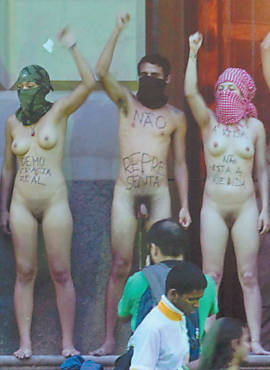
During the Rio+20 event in Rio de Janeiro last June, there were some nude protests. The Folha printed full-frontal photos; the message written across the bare bodies of three protestors was however illegible. As with FEMEN, the message was overwhelmed by the use of nudity to convey it
Protest in São Carlos
At first glance, the São Carlos event appears be different from the others, vulgar and intentionally offensive. The Folha's article starts, "A nude young man simulating masturbation, another exhibiting himself with his penis hanging out of his pants, and yet another pretending to have sexual relations with an inflatable doll." Illustrated with a pixelated photos of Young Man #1. Other news media include partial pictures of a pamphlet, "50 Strokes of a Belt".
Shocking, saddening, etc. But the actual situation is a bit more nuanced.
Event, protest, counter-protest
The young men's nudity was not a random aggression of mores and maidens, but a counter-counter-protest. Let's regress to the first event.
"Miss Bixete", or "Miss Frosh", is a "beauty contest" for freshman girls at the São Carlos campus of the University of São Paulo. They are urged to climb up on a stage, and "show their bodies in a parade", the audience calling on them to flash their breasts. It's a thirty-year tradition, and takes place at the student union building, called CAASO. The student union leaders have in recent years opposed "Miss Bixete".
The protest by the "Feminist Front of São Carlos" took place in front of CAASO, as "Miss Bixete" was taking place. The CAASO doors were open - São Carlos is even hotter than São Paulo, and air conditioning is far rarer in Brazil than in the United States, especially in such places as student associations with limited budgets. The protest included a "batucada", that is, playing drums and other percussion instruments. Signs and banners at the protest included one saying, "We are not inflatable dolls!"
The counter-protest spilled out the open doors of CAASP, and spilled beer, as shown in a video posted online by one of the feminists. It did include an inflatable doll, with which one of the counter-protestors, dressed in a Spiderman costume, simulated intercourse. Photos show that one counter-protester removed his pants, climbed on a bench, and danced. The video doesn't show that, but it does show other counter-protestors swaying to the beat of the batucada. Other supposedly pulled out his penis, but since both he and his trousers are black and the photo is pixelated, we just have the protestors' word for this.
What is violence?
Is drowming out someone else's speech "nonviolent"?
The protestors primly declared, "The demonstration was peaceful and included percussion instruments, music, banners with slogans and pamphlets." Peaceful and non-violent? Bullshit. They came not to protest but to interfere with a previously announced event, which they did with noise. Closing the doors of a packed CAASP in tropical heat was not an option, and in any event since Brazilian doors rarely need to seal off the escape of heat, they're not effective sound barriers, either.
A couple of weeks ago a Cuban blogger, who on her 20th attempt had received permission to leave that island, was shouted down at a number of events in Brazil by young Communists with old Stalinist attitudes. Was their shouting to silence an anti-totalitarian voice, "non-violent"? Was the "batucada" during the Miss Bixete contest, any less violent? Does violence against sexual liberty, differ from violence against political liberty?
Perhaps the feminists should explain that "noise is nonviolent" to anyone who lives next to a bar that plays country music till 3:00 AM on weekends, or to anyone whose neighbor has a barking dog.
Prisoners of rhetoric
Brazilian feminists, like their North American sisters, and often prisoners of rhetoric. Some years ago Harvard students took advantage of a heavy snowfall to during several hours construct a large snow penis. "Feminists" saw it, thought it "offensive", and took a couple of minutes to knock it down. They later claimed to the press that they had "dismounted" it.
Dancing to the protestors' beat
If the feminists were truly offended by a snow penis in Harvard Yard (and one sometimes has the impression that some feminists are offended by any penis, in any situation) there were a number of responses they could have made. Perhaps a snow vagina would have conveyed only an equivocal message, but .. trash bags to make a large condom? A large pair of cardboard shears? An almost-to-scale ruler, showing the large snow sculpture to represent 3"? There are a number of possibilities, but they all require creativity and effort and some time in the cold, which the male students invested, and the feminists did not. They used violence to silence a message they disagreed with. Breaking someone else's work is still breaking someone else's work, and the rhetoric of calling it "dismounting" doesn't change that.
Participation in the Miss Bixete event is voluntary - no girl is required to get up on stage, nor
to remove her shirt if she does so. The feminists complain that women who may not want to participate do so for fear they will be considered "stuck-up" during the rest of the year. Somehow, though, I find the idea that events should be banned so that non-participants don't feel bad for not participating, unconvincing. I always thought voluntary activities were up to the participants, and that non-participants had the option of staying away, not the right of veto.
There is a distinction between a voluntary, public, nonviolent, and non-hazardous activity, and hazing freshman. About a decade ago a pre-med drowned in a swimming pool during freshman hazing in São Carlos, and they have been careful since. But nothing at Miss Bixete offered any physical hazard, though had they closed the doors in a futile effort to escape the batucada, heat stroke could have been a possibility.
Your too-friendly neighborhood Spiderman?
Not their party?
One of the named feminist protestors was Airton Ferreira Moreira Júnior, identified as a professor. A look at his resumé shows that he's a professor not at USP São Carlos, but at another university in the same city, the Federal University of São Carlos. While USP's São Carlos campus specializes in engineering, chemistry, physics and mathematics, Ferreira Moreira's highest academic distinction is a master's degree in sociology.
The organizer of the protest is the "São Carlos Feminist Front", which doesn't seem to be the "University of São Paulo-São Carlos" Feminist Front. They came to impede someone else's party.
Alternative protests
The "Feminist Front of São Carlos" could have with a bit of creativity and humor come up with far better protests. They could have held "Mr. Bixão", either grading the candidates on the same "degrading" bases as the misses are grades, or by the more noble standard they propose, ideas. Well done, either would be effective and funny - though perhaps asking feminists to produce, or even to recognize, humor is akin to asking them to fly over the moon.
Cloth banners and paper dolls
The Inflatable Woman
The counter-protesters brought an inflatable woman. Offensive? Photos of the event show that the feminists had a banner saying, "We are women, not inflatable dolls, we have ideas, we are not manipulated", and along with it, a cardboard model of an inflatable doll. It was the feminists who introduced the idea of inflatable dolls to the event. Is a paper doll less offensive than a vinyl one? Or merely less expensive?
As to the young man who simulated introducing himself into the inflatable doll, well, "Make love not war" conveys the same message, though with words rather than actions, and is clearly protected speech - indeed, it's almost traditional.
"Fifty Strokes with a Belt"
Another of the feminists' objections was to a pamphlet distributed by some of the USP students, claiming it supports physical violence against women. The title "Cinquenta golpes de cinta" is an obvious reference to "Cinquenta tons de cinza", the Portuguese translation of "Fifty shades of gray", and where the local edition describes the real book as a New York Times best seller, the parody has : "The cure for the hot pants of these women who aren't getting any - The New York Times."
Offensive? Certainly, and so was "A Modest Proposal". But to say the students are proposing beating women in like saying Dean Swift was seriously proposing eating Irish children.
Converging on "Slutwalk"
Interestingly, both the park event in which women were nude in public, and the protest in São Carlos which objected to women being denuded, point to "Slutwalk" as kindred in spirit to what they were attempting. The Feminist Front's manifesto said:
"We repeat that the Slutwalk's objective in displaying the body is totally contrary to that of Miss Bixete. In Miss Bixete, the bodies are displayed to satisfy the desire of a specific gender. And not just any bodies, they are bodies chosen according to the reigning standard of beauty. In the Slutwalk, we display our bodies to protest against this oppressive standard. We display our bodies, whether they are white, black, thin, fat, perfect or imperfect. We display our bodies not for the pleasure of others, but to affirm our freedom of choice."
We have here, I think, not an argument about liberty, but an argument about control. The Feminist Front wishes to replace the male chauvinist rules for the display of women's bodies, with their own female chauvinist rules for the display of women's bodies.
The event in Ibirapuera sought to free nudity from naturist ghettos, making nudity acceptable, unremarkable and insignificant. The Feminist Front sees women's bodies as a battleground, and wants to win the battle.
The right of free expression
The "Feminist Front of São Carlos" crossed a line - a Constitutional line, even - when they decided on disruptive noise as their tactic. They could have protested quietly, or they could have picked another time, or another place. They purposely provoked college students who they knew would be drinking, and when they provoked incivility, used it to claim that the reaction to the disruptive protest just confirms that the e original event was "disrespectful and violent."
It was the Feminist Front's demonstration that was "disrespectful and violent". The Ibirapuera protestors were told it was fine to take their pants off, but not to disrupt a previously scheduled event. The feminists chose to disrupt with noise, a previously scheduled event. Both English idiom and American law recognize the concept of "fighting words": provocation that invites a reaction, and a reaction that is justified by provocation.
The feminists provoked, they got a reaction: they brought a paper inflatable doll, the counter-protesters brought a vinyl one, which they used to act out what the feminists implied. The response is direct and not out of proportion. The feminists played music in a public place, and how can the object if someone chooses to dance to it?
Certainly the men displayed a lack of class - and the women displayed a lack of humor. Between the two groups, I for one prefer the company of those who have humor.
 “Era naturismo en familia, sin connotación sexual”, disse o dono da escola-veleiro Léonide Kameneff, preso em Venezuela em 2008, extraditado e condenado em Paris neste março a 12 anos de prisão por abuso sexual de cinco dos mais de 500 jovens, tipicamente entre 11 a 13 anos, que participaram do projeto educacional alternativo entre 1979 e 2002.





 Postagens


